

The Simplest Thing You're Overthinking
A love letter to the messy, imperfect, life-changing practice of easy journaling.

The light is changing. It’s March 19th, and there is that specific, restless energy in the air that comes right before the official start of Spring. I was sitting with a gift I received recently, a book titled A Year of Self-Care, and it felt like a quiet challenge.
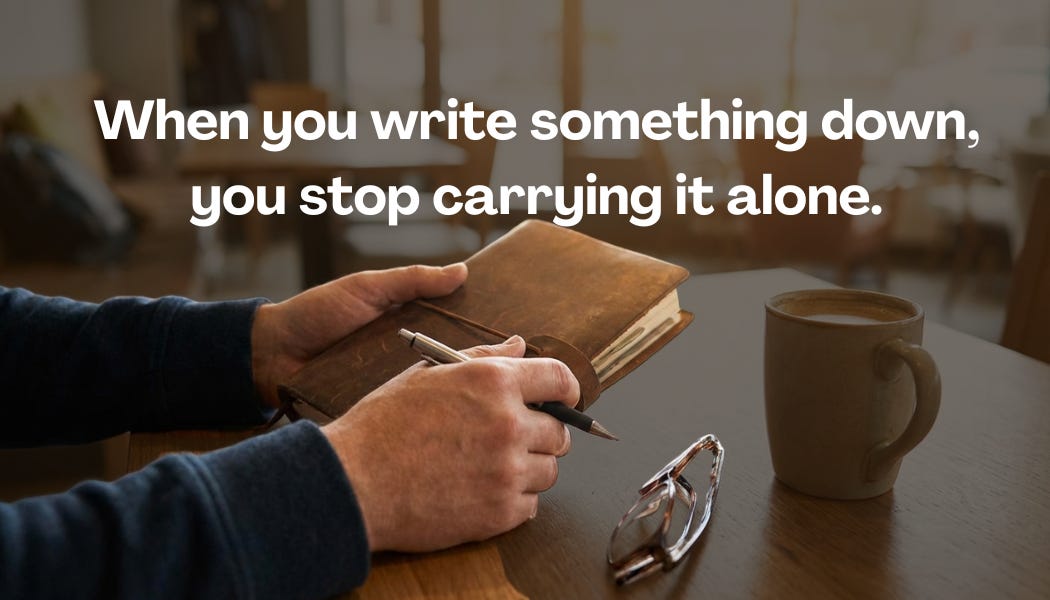
We talk a lot about “self-care” in these digital pages, but usually, we frame it as another mountain to climb. Another habit to “master.” Another streak to maintain on an app. But today’s practice was different. It was a call to do something radical: to make it easy.
I’ve been thinking about my friend Priyanka. We were catching up recently, and she mentioned how she wants to write more on Substack but struggles to stay regular. I get it. We all do. We wait for the “perfect” moment, the “perfect” notebook, and the “perfect” insight.
But what if we just... didn’t? Today, let’s talk about Journal Easy.
Why “Journal Easy” exists at all
Because your mind is not a hard drive. It’s a crowded room.
Journaling, specifically expressive writing, has been studied for decades as a way to reduce stress and help people process emotions. In one well-known line of research, writing about difficult experiences for a few short sessions was linked to fewer health center visits over the following months, compared with neutral writing. Pennebaker describes early findings as students visiting the health center at about half the rate of controls after writing about traumas for four days, 15 minutes a day (Pennebaker, Expressive Writing in Psychological Science). A broader overview of the field also summarizes that the “trauma-emotion-fact” writing group reported better mood and fewer health center visits in the months after the intervention (Gao, 2022, Frontiers in Psychology via PMC).
And it’s not just “feel better” in an abstract way—expressive writing has also been associated with changes in stress physiology. For example, a randomized controlled trial in PTSD participants found expressive writing attenuated cortisol responses to trauma-related memories (Smyth et al., 2008, PubMed).
So yes: journaling can be self-care in the truest sense, not because it’s pretty, but because it’s processing.
WHAT Is “Journal Easy”?
This is the part where I want to exhale.
Journal Easy is not a system. It is not a 5-step framework or a 30-day challenge. It is not morning pages, bullet journaling, gratitude logging, or any other structured practice, unless you want it to be.
Journal Easy is simply this: write something, somewhere, today.
That’s it. That is the entire methodology.
It could be:
Three words that describe how you feel right now
One sentence about what you’re dreading and why
A list of things you noticed today, a color, a smell, a moment
A question you don’t have the answer to yet
Something someone said that stayed with you
What you ate for lunch and why you chose it
A memory that surfaced out of nowhere this morning
There are no wrong entries. There is no minimum word count. There is no “good journaling” and “bad journaling.” There is only the act of showing up to the page, however briefly, however messily, and that act alone is enough.
The philosophy behind Journal Easy is borrowed from a concept in behavioral psychology called “minimum viable habit.” The idea is simple: the version of a habit you will actually do is infinitely more valuable than the perfect version you never start. A two-minute journal entry every day will change your life in ways that a beautifully planned 30-minute practice you abandon by Thursday never will.
WHEN Should You Journal?
Here is the honest answer: whenever you will actually do it.
But let me give you a little more to work with, because timing does matter — not because there’s a “right” time, but because anchoring a new habit to an existing one is the fastest way to make it stick.
Morning journaling is the classic for a reason. Your mind is quieter before the day has had a chance to pile on. Writing in the morning is like clearing the windshield before you drive, you see more clearly, you’re less reactive, and you start the day with a sense of intention rather than just momentum.
Best for: Setting the tone. Processing dreams or anxieties. Deciding what matters today.
Midday journaling is underrated and wildly practical. A five-minute check-in at lunch, how am I actually doing right now?, can be the difference between a day that runs you and a day you run.
Best for: Recalibrating. Releasing the morning. Resetting your energy.
Evening journaling is where the real excavation happens. The day has given you material. Now you get to make sense of it. What happened? How did it feel? What do I want to do differently tomorrow?
Best for: Processing. Gratitude. Emotional closure before sleep.
The 2am journaling, and yes, this counts, is when something wakes you up and won’t let you go back to sleep. Keep a notebook on your nightstand. Write the thing down. Let your nervous system know it has been heard. Then sleep.
Best for: Releasing the grip of anxiety. Capturing the ideas that only come in the dark.
The only rule? Pick one time and try it for seven days. Not thirty. Not a year. Just seven.
WHERE Should You Journal?
Anywhere that feels like yours.
I know that sounds vague, so let me paint some pictures.
The kitchen table before anyone else wakes up, with coffee you made just for yourself and the particular silence of early morning. The notes app on your phone while you’re waiting for the train. A legal pad at your desk during the ten minutes between meetings. The back of an envelope in your car before you walk into work. A voice memo on your walk, because sometimes speaking is easier than writing and it still counts.
The location is not the point. The consistency of returning is the point.
That said, if you want to create a journaling space, here’s what actually helps:
Low friction. Keep your journal where you’ll see it. Not in a drawer. Not in a bag. On the counter, on the nightstand, on your desk. Visible things become habits. Hidden things become forgotten.
A pen you like. This sounds trivial. It is not. The small sensory pleasure of a pen that writes smoothly is a real and legitimate reason to sit down and write. Honor it.
No phone. Or at least, phone face-down. The journal is a conversation with yourself. The phone is a conversation with everyone else. They cannot happen simultaneously.
THE BENEFITS — And Why They Sneak Up On You
Here’s the thing about journaling that nobody warns you about: the benefits are not dramatic. They are quiet. And then one day, they are everything.
You won’t finish your first entry and feel transformed. But six weeks in, you might notice that you handled a difficult conversation with more grace than usual. Three months in, you might realize you haven’t had that particular recurring anxiety in a while. A year in, you might read back through your entries and see, with startling clarity, how much you have grown, not because life got easier, but because you got better at living it.
Here is what consistent, easy journaling tends to do over time:
🧠 Mental Clarity - The act of writing forces your brain to organize itself. Vague anxieties become specific problems. Specific problems become solvable.
💛 Emotional Regulation - You become less reactive when you have a daily practice of processing your emotions. You’ve already had the conversation with yourself. You’re not carrying as much into the room.
🔍 Self-Awareness - Patterns emerge. You start to notice what drains you, what lights you up, what you keep avoiding, what you keep returning to. This is the beginning of real self-knowledge.
😴 Better Sleep - Writing before bed is one of the most evidence-backed ways to quiet a busy mind. You’re essentially telling your brain: I’ve recorded this. You can let it go now.
🌱 A Record of Your Own Life - This one is underestimated. Your life is happening right now, in the ordinary Tuesday moments and the quiet Wednesday mornings. Journaling is how you bear witness to it. Future you will be grateful.
💪 Resilience - People who journal through hard times tend to recover faster. Not because writing erases pain, but because it helps you make meaning from it. And meaning is what we’re all really looking for.
A Note Before You Go
I was gifted a book recently, A Year of Self-Care, and today’s practice was this: Journal Easy.
Not journal perfectly. Not journal profoundly. Not journal in a way that would impress anyone.
Just easy.
I think that’s the invitation for all of us today. To take one thing we’ve been making hard, one practice, one habit, one relationship with ourselves, and ask: what would the easy version look like?
And then do that.
Grab whatever is nearby. Write the date. Write one true thing.
That’s the whole practice. That’s the whole point.
Love this piece, spot on in so many ways !